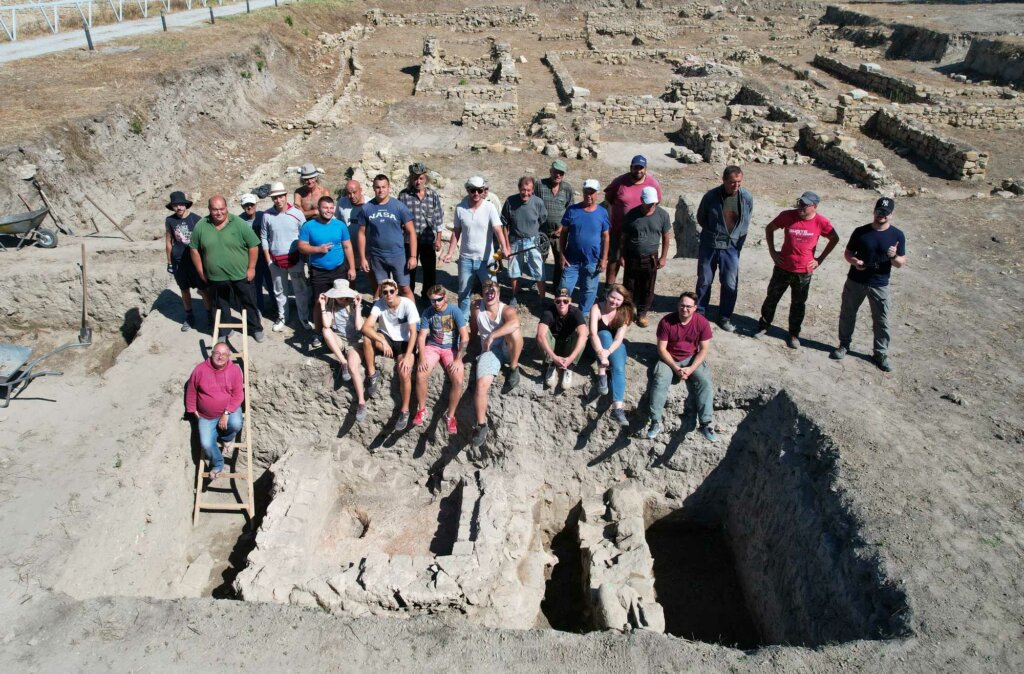


Summer with the Centre II
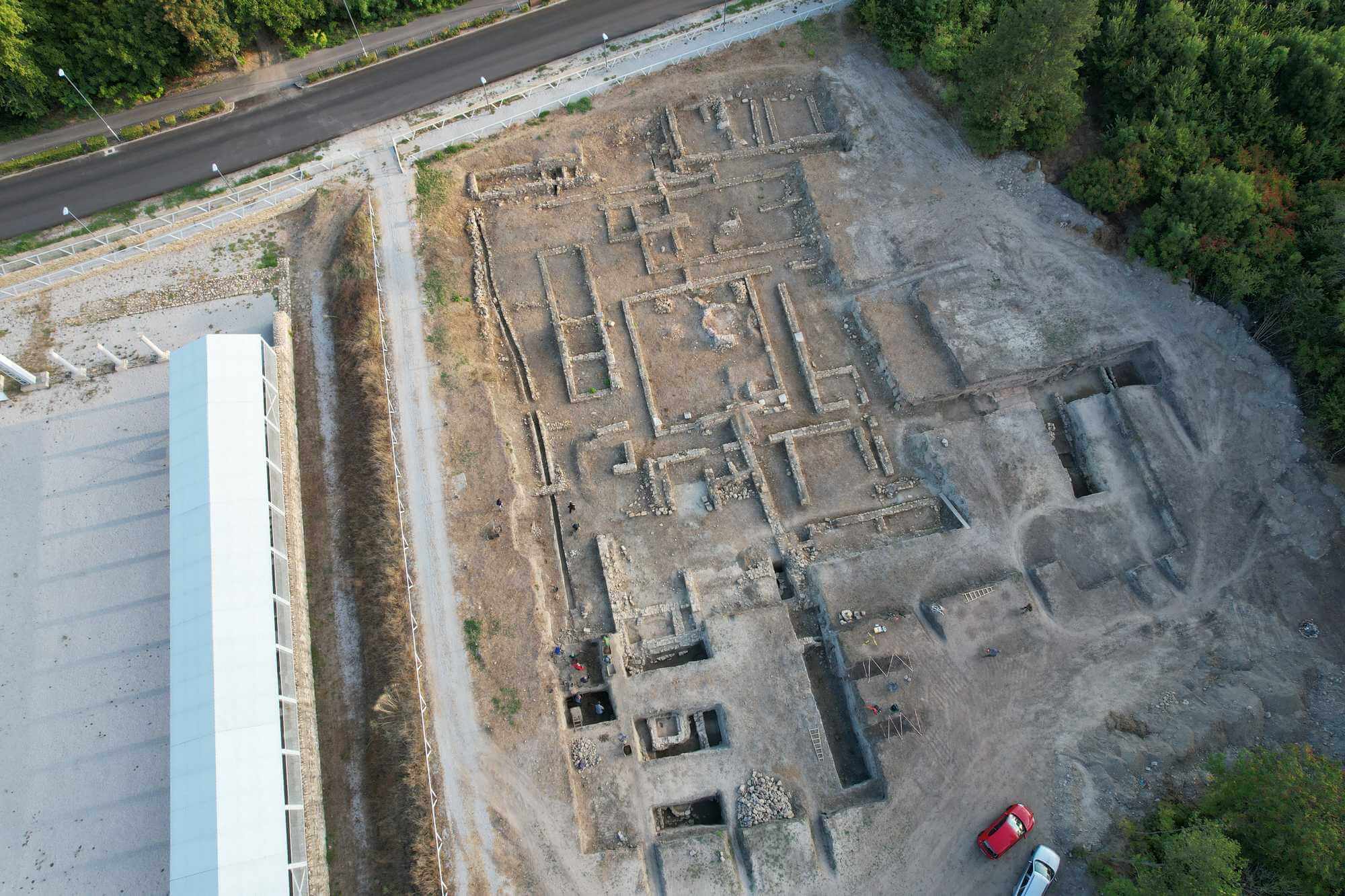
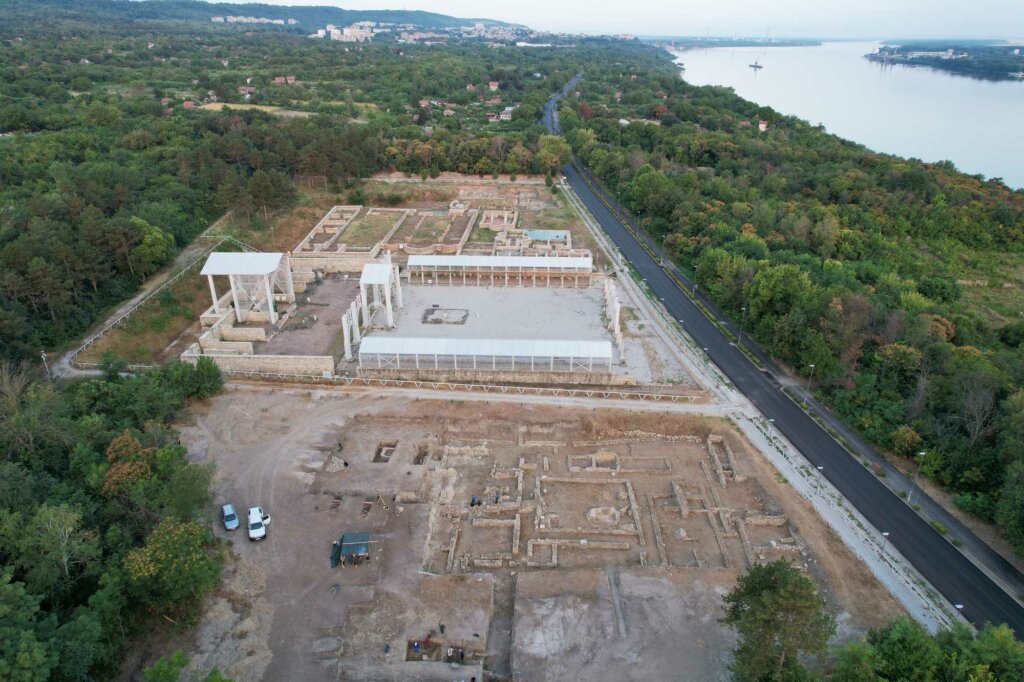
Meanwhile, on the lower Danube, the long-awaited excavation campaign at Novae is slowly coming to an end. After a two-year hiatus due to a pandemic, we found our excavation section heavily overgrown and eroded. The preparation of the excavation itself was therefore a challenge, but thanks to the great commitment of our student-practitioners we were able to overcome this within the first few days. The excavation started in hellish heat, with temperatures fluctuating around 40 C, which for obvious reasons – safety – slowed down our work. However, we consistently conducted research while waiting for cooler days to arrive.
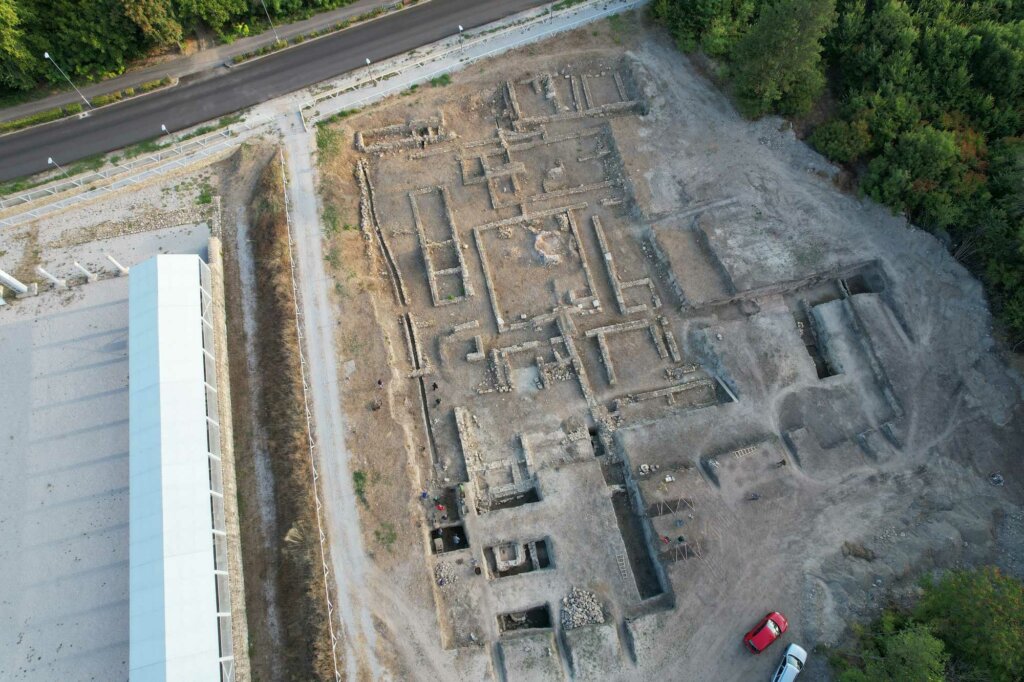
The scientific programme for this year envisaged the capture of the eastern boundary of a vast and luxurious residence most probably belonging to a primus pilus, the first centurion of the first cohort of Legio I Italica. The next task was to uncover further fragments of the, as it now turns out, almost 40 m (!) long hypocaustic system, which should constitute the southern boundary of the building complex.
Naturally, we carried out our work down to the lowest levels, i.e. the layers connected with the wooden barracks of the 1st cohort of the Augustus VIII legion. Our task was to capture further rooms of the so-called Centurion House and to locate another complex of double wooden barracks – located to the east of the one currently under investigation.
Pretty soon it turned out that archaeological luck smiled on us. Excavations focused on the study of architecture yielded excellent results. It turned out that the wooden barracks were very well preserved, which allowed us to determine a number of details of their construction. We also obtained certainty about their layout within the investigated sector of the camp. In this respect, our working hypotheses were confirmed. As it seems, we even discovered – an unusual rarity – a “centurian” toilet. We have captured the eastern boundary of the House of the Centurion of the First Cohort of the I Italic Legion and the street separating this complex from the hypothetical seat of the Second Centurion of the First Cohort.
We know with certainty that the Centurion’s House was partially destroyed, most likely by an earthquake, around 80 AD. Shortly after the cataclysm, the hypocaustic system, which was interrupted in some sections, and the entire complex of rooms around the baths and heated rooms were rebuilt. It was given a luxurious character by decorating the walls with paintings and laying new floors.
During this year’s campaign we also uncovered two pools: one square and the other semicircular, with an apse, both probably belonging to the aforementioned bathing part of the complex. A large ceramic water supply was also captured, no doubt linked to the functioning of the baths.
Unexpectedly, one of the most interesting discoveries in the category of movable monuments turned out to be a set of kitchen utensils used in the Centurion House. Kitchen utensils usually do not arouse much interest, but this set is exceptional. Not only is it made of excellent clay, but it also presents a full set of used forms, indirectly giving us insight into the culinary tastes of the primus pilus of those times.
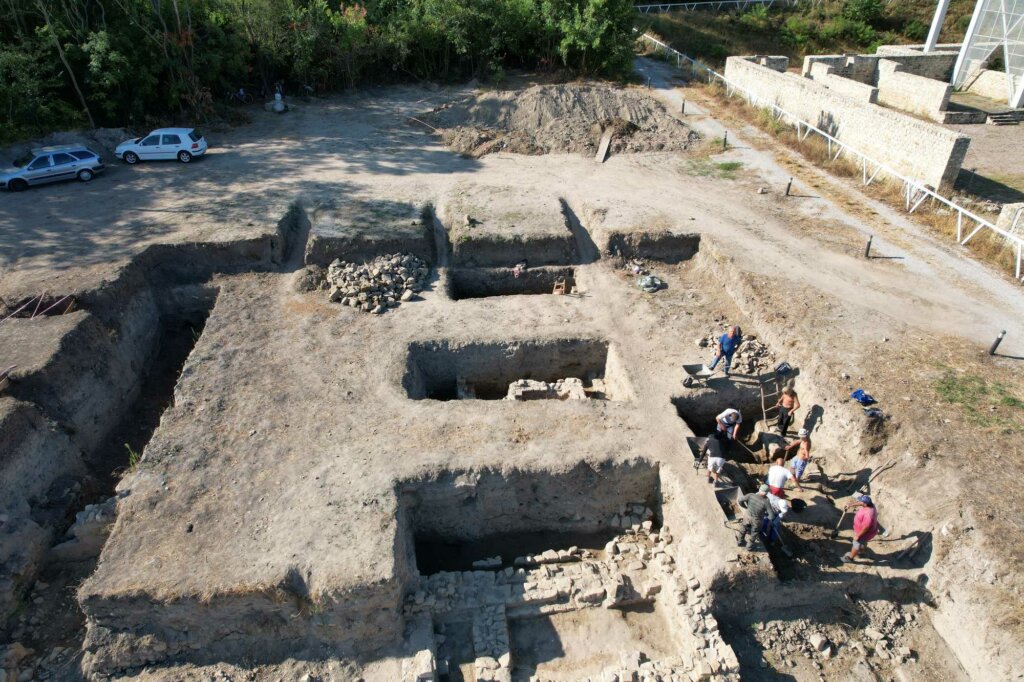
On the ruins of the Centurion’s House another building was soon erected, this time a civilian one, whose owner was engaged in the manufacture of glass. We discovered another furnace for its melting, but also a fragment of an extremely rare glass vessel – a thin-walled bowl (wall thickness less than 1 mm) covered with gold foil.
We also obtained new data on the architecture of Novae in the 5th century AD. We came across a fragment of another spacious house built by the tribes who arrived here, made of wood and clay. On this basis it may therefore appear that, all things being equal, Novae was still a major settlement centre at the time of the migration of peoples.
As in every campaign, we also undertook prospecting surveys. These aimed at capturing sections of Roman roads, locating ancient quarries and sources of clay for making bricks and pottery. The results obtained and the samples taken will allow for a more synthetic study of this important subject. Movable monuments add their “commentary” to the uncovered architectural content. This is mainly about the context and dating. Coins, appliqués, glass and ceramic vessels, bronze and iron objects. This whole set of data after each campaign allows us to clarify the history of individual buildings. This is all the more important because Novae is a unique site, which every year provides completely new, often completely surprising information. It should be remembered that currently there is no other site in the whole of Europe where the complex of wooden barracks belonging to the 1st cohort and the Centurion’s House would be examined as a whole. Nowhere have these types of structures been uncovered sufficiently to allow general and binding conclusions to be drawn about the architecture, functioning and history of changes to these buildings.
The planning and organisation of important international conferences, previously suspended due to the pandemic, is also slowly starting. If the situation in Europe does not deteriorate again, we will soon have the opportunity to present our latest achievements at these conferences. In particular, at the Limes Congress planned for the summer of 2022 in Nijmegen, but also at the RCRF Congress on Roman Ceramics and Provincial-Roman Art.

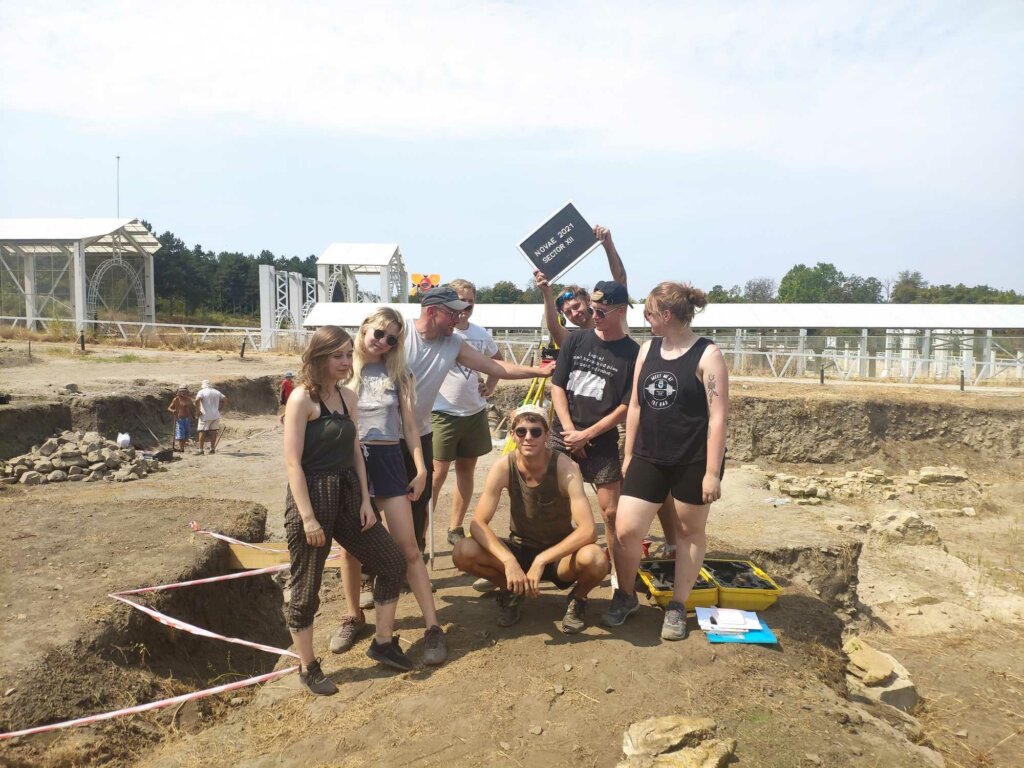
During this year’s excavation campaign at Novae we also held a two-week workshop for students as part of the Eurotech project. Due to pandemic restrictions a small group took part in them.
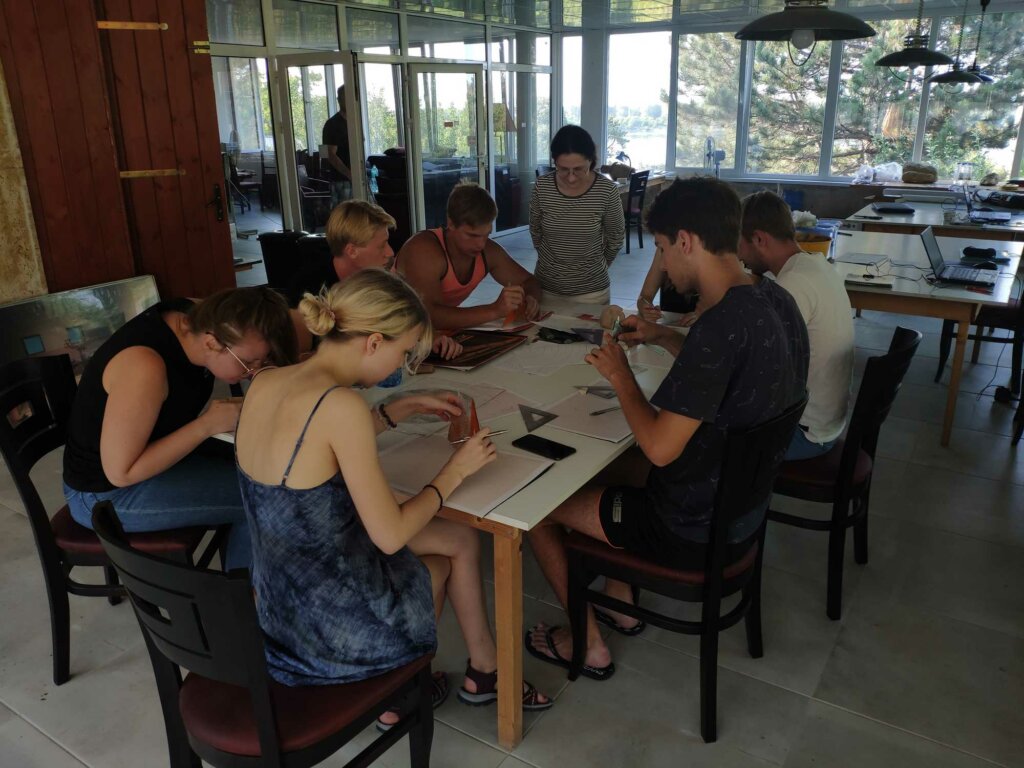
The participants learnt about the methodology of archaeological research and how to document archaeological artefacts using traditional methods as well as RTI.
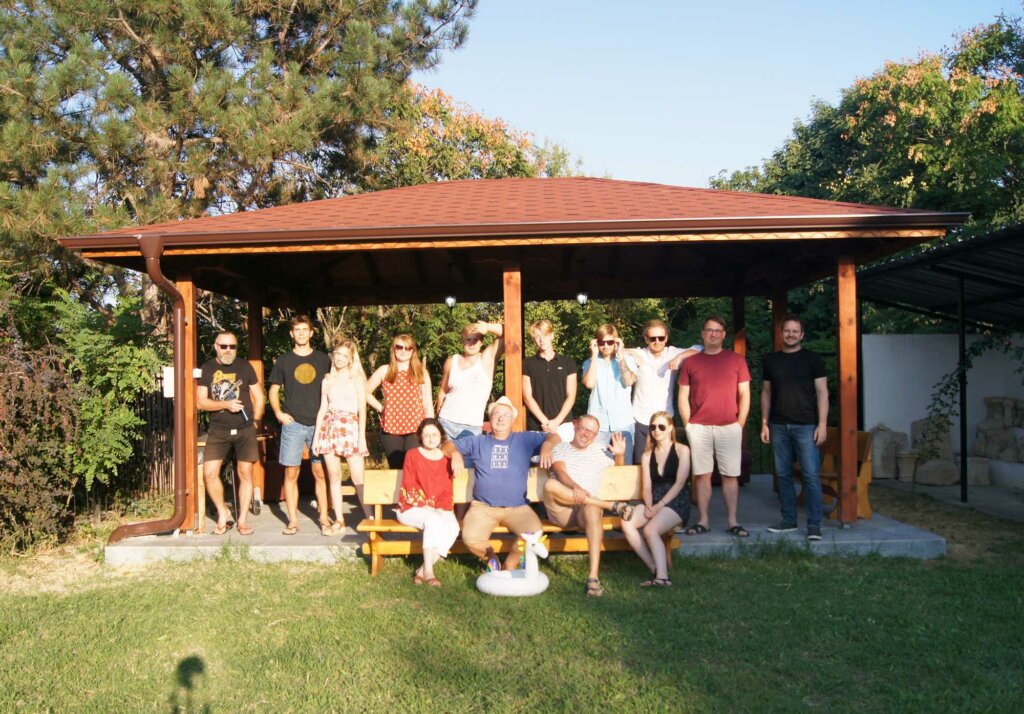
No less important for the participants were the aspects of an excavation campaign involving the management of people and the scheduling of work to achieve pre-defined goals.