

Summer ’26 with the Centre, VI
News from the Excavations at Novae
We have not had a week this crazy at Novae for many years. It all began in true Hitchcock fashion – with a sudden collapse in the weather. After a month without a single drop of rain, which had left the entire excavation covered in 30 cm of fine loess dust swirling into the air at the slightest gust of wind, Armageddon arrived during the night. Naturally, the trenches were flooded, so we had to take a day off – unfortunately, to be made up on Saturday.
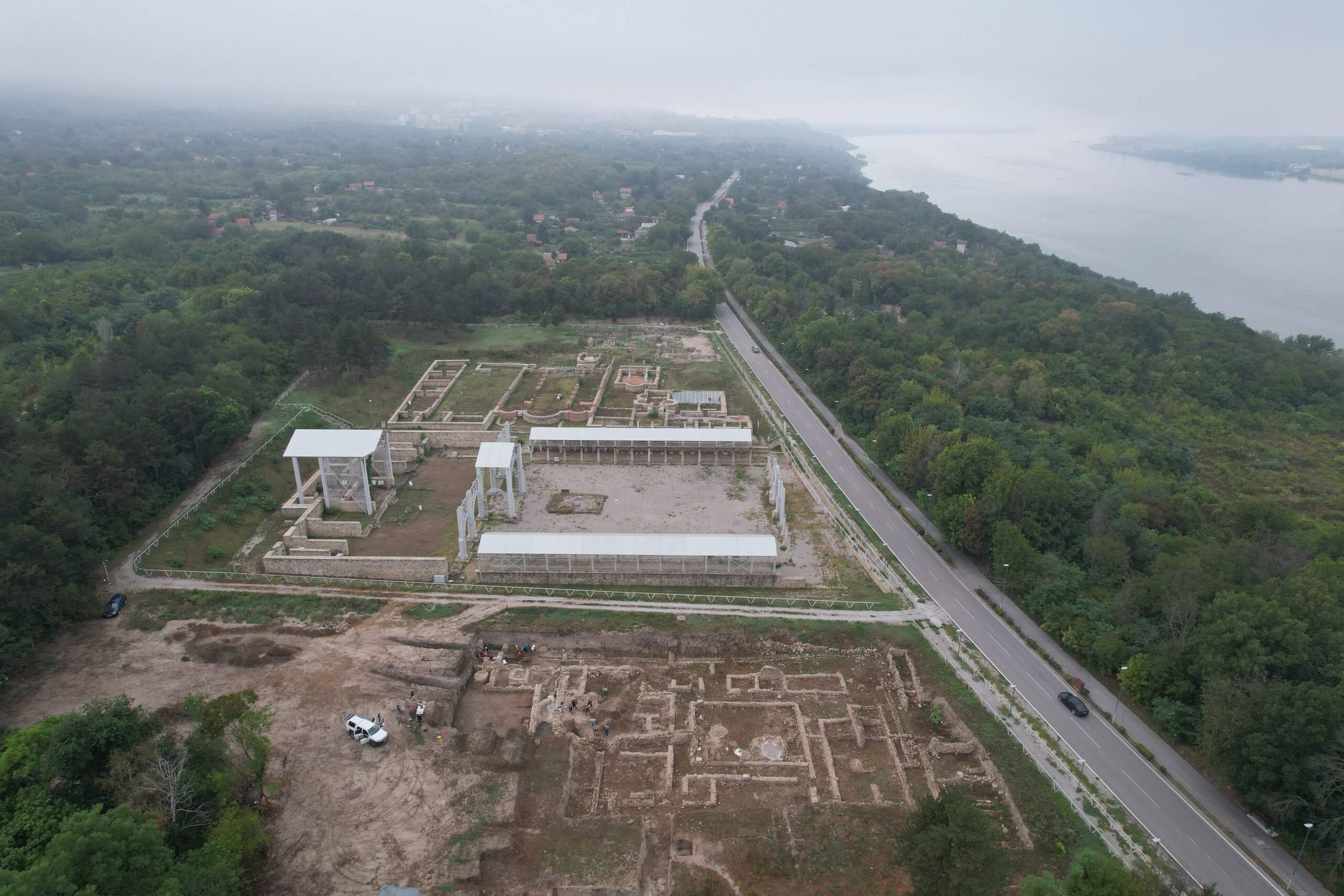
Then came three days of filming with a French crew working on “The Rise and Fall of the Roman Empire”. They focused mainly on the excavations conducted by our Centre, namely the military hospital and the new sector currently under investigation. Filming in the hospital was particularly demanding, as it now resembles a genuine jungle – heat, vegetation everywhere, and endless pauses while the crew searched for the right shots, the right light, and the latrine we restored years ago, now almost completely lost in the undergrowth.

At the excavation area, of course, they filmed the trenches themselves, our students at work, walls, basins, and some of the “fresh” finds – including a rather nice gaming die and a stamped roof tile that happened to appear at just the right moment.

After this “cinematic interlude”, there came a brutal return to reality. Our brave students had to painstakingly level more than 300 m² of rubble from the barracks. Once everything had finally been beautifully prepared, another storm arrived overnight, and in the morning we found a calm lake covering the entire area. As a result, only a small part of the barracks could be documented. As we like to say: it lay underground for 2,000 years, so it can stay there for another year.
The same could not be said of various walls. Naturally, those we had been stubbornly searching for either survived only as negatives or – equally naturally – chose to emerge on the penultimate day. The team cleaning the walls was “delighted”. On top of that came the removal of sections of painted plaster, and just when it seemed that nothing else would emerge in situ, a carefully laid floor made of small bricks appeared.

Of course, all these structures required photographic documentation. And since they stubbornly chose to reveal themselves in the middle of the day, we had to use a “human screen”, casting shade over the exposed features. The screen itself was quite cheerful!

We were no longer expecting many portable finds either… And yet first came the gold setting of a ring, which had once held a gem or another stone – we will probably find that next year! Then came a series of stamps of Legio I Italica, with the legion’s name incorporated into the shape of a warship – an absolute rarity. There was also an unusual roof tile with a vent, fragments of amphorae with dipinti, and finally – the heavy artillery: a beautifully preserved Corinthian capital decorated with a theatrical mask.
We have chosen to treat this smiling face as the smile of Novae itself, allowing us to bring the excavations to a close on a particularly strong note.

The refrigerator experiment was also successfully completed. Along the bank of the Danube, we found further fragments of pottery and roof tiles. We spent an entire day driving through the scrub in search of water sources along the routes of the ancient aqueducts, followed by some makeshift chemical-laboratory work, testing pH and acidity in preparation for future chemical analyses. And then there was the full-day expedition to collect clay samples from as far away as the area near Tarnovo, under the command of the indispensable Professor Inga Głuszek.

Then came the day when the students had to leave… There were tears.
And we still have an entire week of painstaking documentation ahead of us. We are simply buried in data, with photographs still to be taken, almost 30 metres of profiles to finish drawing, inventories to complete, finds to hand over… Phew!
Well – that is the profession. But I do not think anyone is complaining.
There was also an engineering operation. We had to lift the discovered altars and transfer them as an intact arrangement to the lapidarium. Operation “Altars” lasted many hours and required enormous care and dexterity. It was an extremely difficult undertaking. Nevertheless, we successfully reconstructed the original arrangement of the stones from the excavation inside the lapidarium.
Once back in Poland, there will still be a tremendous amount of work ahead of us: studies, analyses, and documentation. But it is difficult not to feel proud of such a successful and rewarding campaign.
We managed to complete the planned programme and obtain answers to questions that had been “grinding away at our modest intellects” for many years.
This season, Novae spoke with its full voice.
And perhaps that is exactly how this season should end.