

Summer ’26 with the Centre, IV
It is high time for another round of news from Novae! This year’s campaign has been exceptionally busy. At times, it feels as though Novae has decided not to give us even a moment for coffee.
As we reported last weekend, we carried out a survey of the Danube riverbank. We did indeed encounter architectural elements, structures that are difficult to interpret at this stage, and concentrations of pottery. All the collected evidence, together with the GIS data, will now have to be processed and analysed. Unfortunately, we will only be able to do this once we return to Poland, as further challenges are already awaiting us here in Novae.
The coming weekend will also be connected with the Danube and the implementation of an EU programme. This time, we will travel by boat from Belene – ancient Dimum – to an island near the village of Vardim, where a Roman municipium once stood. We will also document walls that have emerged in the waters of the Danube, primarily to determine whether they are indeed ancient structures. In other words: river archaeology!
Our remaining “water-related” plans include collecting samples from springs that probably supplied the aqueducts serving Novae, as well as sediment samples from ancient water pipes.
And what is happening in the trenches? You can see what the site looks like and how rapidly the work is progressing in our video. And perhaps even join the dance!
This year is unquestionably marked by Late Antique coins. It is almost as if each new series were being “planted” for us on request by the genius loci! Until now, we had been able to reconstruct the chronology from the first to the early fourth century in considerable detail. Later political upheavals and the series of incursions between the fourth and sixth centuries meant, however, that Late Antique buildings were destroyed and their walls robbed out. The coins recovered from these layers could therefore provide only broad chronological brackets, without allowing us to establish a more precise sequence.
This time, Late Antique coins predominate and, importantly, they come from secure stratigraphic contexts. Once again, Novae is making our work considerably easier. What is more, this year it has also “offered” us several unique finds.
First and foremost, we discovered an exceptionally well-preserved altar bearing a beautifully cut inscription. We also found a fragment of a second, unfortunately damaged altar, on which parts of another inscription survive.
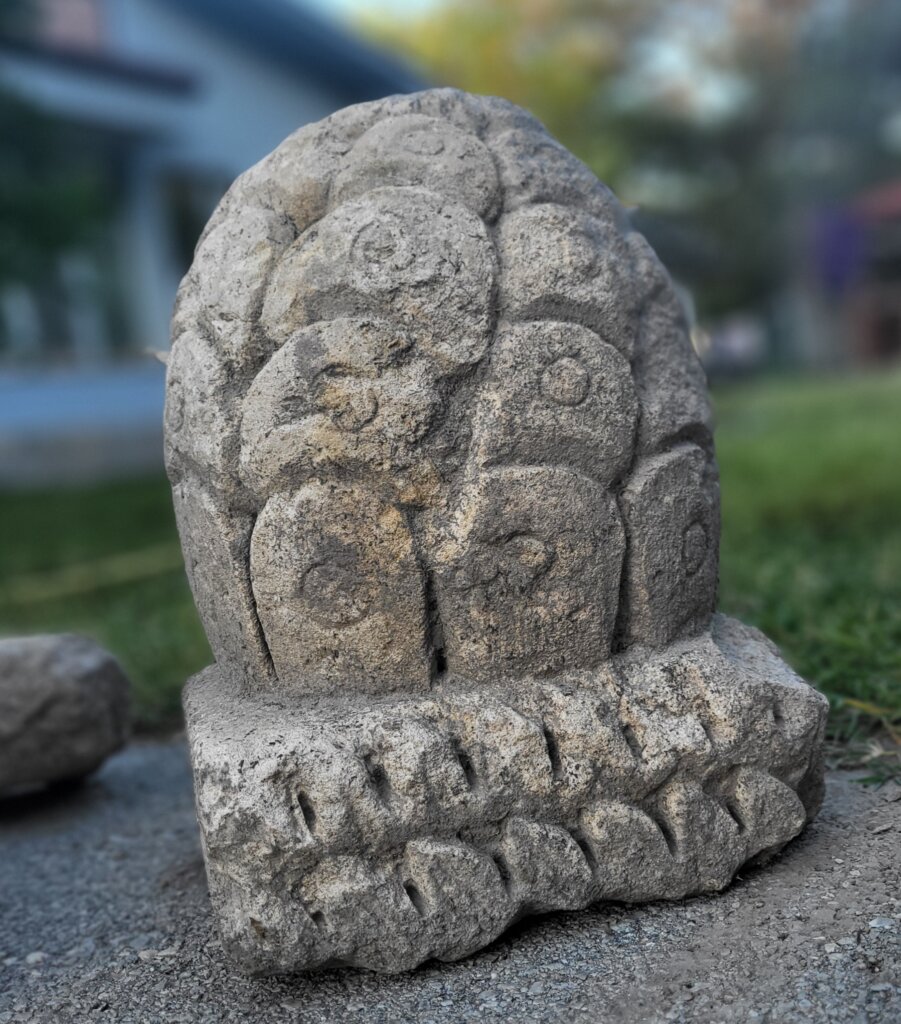
A complete surprise was the discovery of a sculpted pine cone, nicknamed “the egg” by the students because it really does look a little like an alien egg. This is a rare find at Novae – only the second example discovered here. Such objects may be associated with both funerary and cultic contexts.
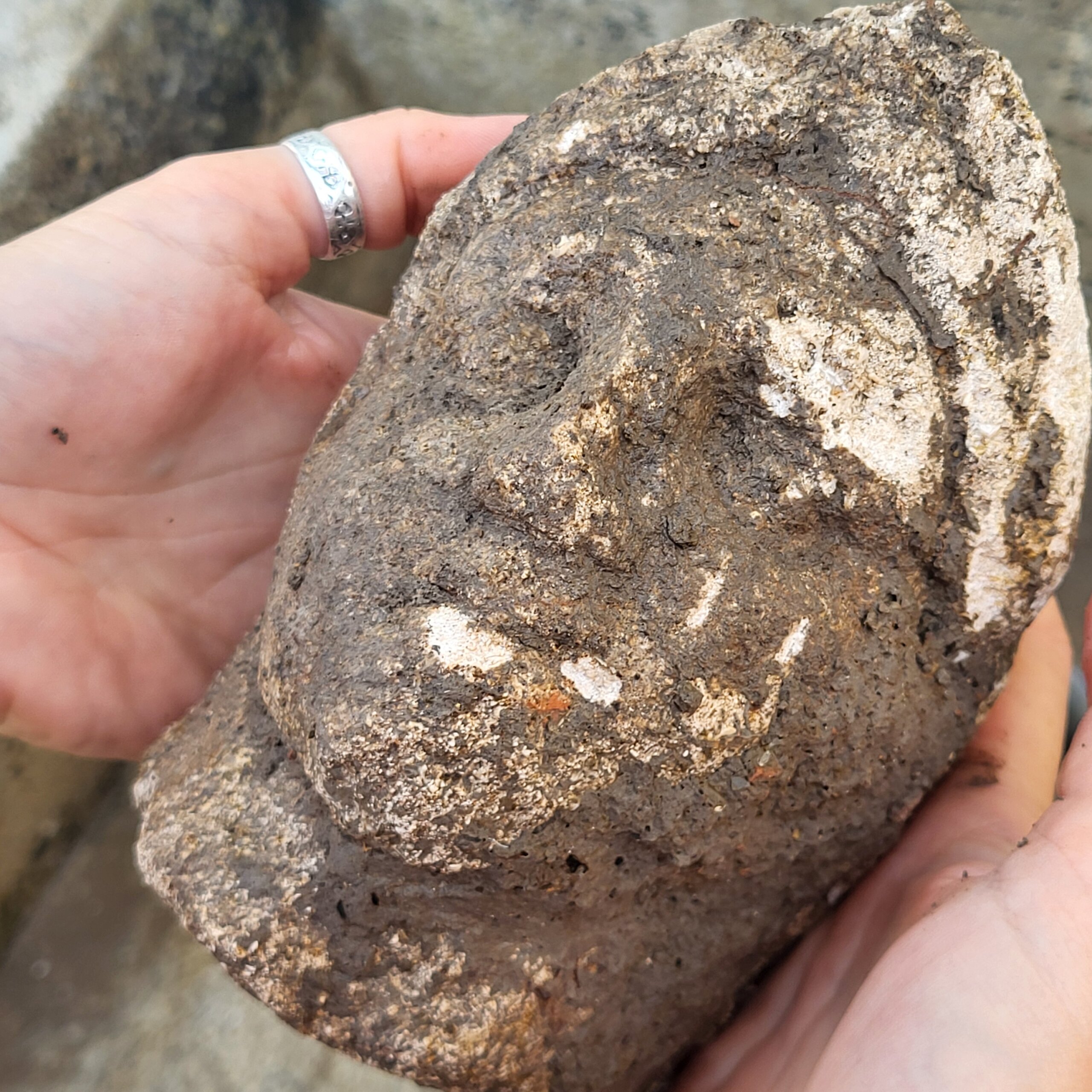
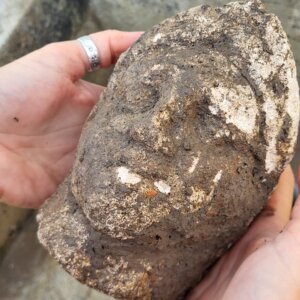
And then there are the truly exceptional discoveries: a head of Mithras and a fragment of a statue, probably depicting Diana.
New inscriptions are now found relatively rarely, yet the area we are investigating has already yielded several – and some of them are truly remarkable. These include the famous inscription mentioning Novae by name, commissioned by the magistrates of Alexandria Troas and Ilium – in other words, Troy!
Sculptures are equally rare discoveries, while the head of Mithras is altogether exceptional.
The results obtained so far would already be enough to “satisfy” our ambitions not for one, but for at least two excavation campaigns. And yet we still have an early Roman building to uncover, in whose hidden corners further archaeological revelations are very likely awaiting us.
This year’s campaign is also exceptional because of the sheer number of remains being uncovered in situ – or, to put it more vividly, a wall upon a wall, with yet another wall on top.
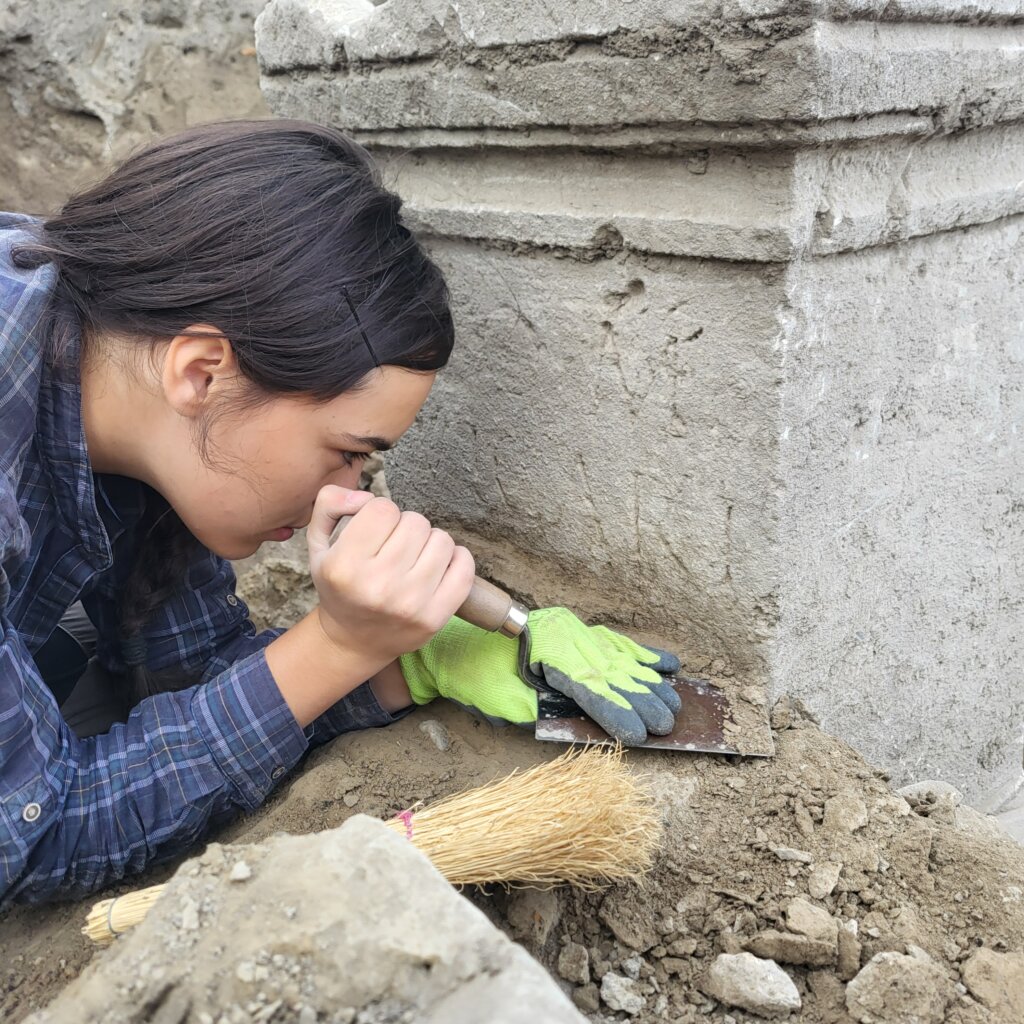
Our remarkably efficient and cheerful student team certainly has plenty to do. There is also pottery to draw, temperatures to monitor as part of our “Roman refrigerator” experiment and, above all: cleaning, cleaning and yet more cleaning of the walls.
Another idea has also emerged, prompted to some extent by practical necessity: preparing the ingredients needed to produce hydraulic mortar, which we will use to conserve the hypocaust system. Crushing fired clay is hard work, but our “hammer crew” are doing an excellent job.
Fortunately, the group works well together and is exceptionally well organised, while their curiosity and eagerness to learn new things make the work genuinely enjoyable. Our resident instructor in taking measurements with various mysterious-looking instruments, Bartek Wojciechowski, therefore has plenty of opportunities to demonstrate his skills. Krzysztof Narloch teaches the essentials of archaeological fieldwork, Adam Jarych takes the whole group diving into a sea of pottery, and Agata Momot makes sure that the lines we draw really are straight… And the Boss? That remains a great mystery.
The coming week will bring work in layers dating from the first and second centuries AD, as well as the beginning of conservation work on the western sections of two bathing pools.
Let us only hope that the “God of the Skies” grants us good weather.
Here’s to a new week. Here’s to adventure!