


Summer ’26 with the Centre, III
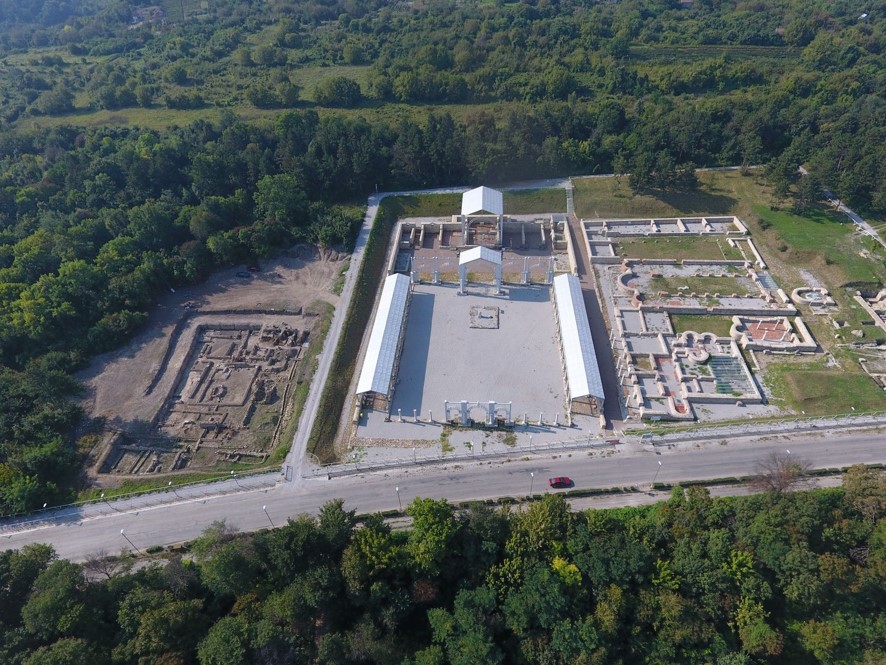
And…excavations at Novae have begun! As usual, we are working with an international team, and this year we are joined by colleagues from Italy, Bolivia and Romania.
The past week has been so busy and so extremely hot – something that, we suspect, people in Poland can currently understand very well too – that we are only now, with a slight delay, sharing the first news from this year’s campaign. And our plans are exceptionally ambitious: varied, intensive and packed with work from dawn until… the next dawn.
To begin with, we were met with a rather unpleasant surprise. We found the excavation area in a disastrous condition – overgrown with grass, young trees and shrubs. The effects of an exceptionally snowy winter and rainy spring were such that, for a moment, one could have thought we had arrived to study the growth and evolution of plants rather than an archaeological site. Unfortunately, some of the trench sections and walls had also been damaged.
We therefore spent the first few days not only clearing the excavation area, which now covers more than 3,000 m², but also carrying out intensive conservation work. We rebuilt and reinforced more than 400 metres of walls. The work also included the pools and the caldarium of the baths. We still have to construct special protective surrounds for three pools, as well as reconstruct and secure the hypocaust pillars.
During this year’s campaign, we are also carrying out three additional research projects. One of them was, in a sense, suggested to us by nature itself. The exceptionally low level of the Danube has exposed numerous worked stones and fragments of pottery on the wide riverbank below the fortress of Novae. This weekend, we are planning a survey of two sections of the bank: one along the fortress and another in the area of the nearby site of Ostrite Mogili, where a Roman municipium was probably located.
Some of the stone elements discovered there will be transferred to our lapidarium, while those that cannot be moved will certainly not be left undocumented. All artefacts will be recorded with GPS coordinates, and pottery assemblages will be analysed with particular attention to their spatial distribution.
Another project concerns the Roman aqueducts. Their general course has been known for a long time, but until now there has been no opportunity to conduct a more detailed analysis of the water sources. This year, we will collect samples from more than 25 springs that are still active today and may have supplied Novae with water in antiquity. Deposits preserved inside ancient lead pipes will also be examined.
We are also continuing the next stage of a European Union-funded programme devoted to the analysis of climate change in antiquity. Sediment studies will be carried out both within Novae itself and in its immediate surroundings.
This year, we have also begun an archaeological experiment involving the “famous” Roman refrigerators from Novae. At our field base, we recreated the conditions in which these containers would have functioned in Roman times, and every day, at fixed times, we measure changes in temperature. We deliberately began the experiment in the hottest month of the year – if the “refrigerators” can cope with these conditions, they will demonstrate both their usefulness in antiquity and the ingenuity of the Romans. The first results are genuinely very promising.
We are also hosting researchers who are currently studying finds from Novae, including tableware and fibulae. We are joined as well by the archaeometrist Pepe from a laboratory that collaborates with our research centre.
And as if all these responsibilities were not enough, from 24 to 27 August an episode of the well-known documentary series Rise and Fall of Rome will be filmed at Novae. This will be an excellent opportunity to present the results of our many years of research to a broad international audience.
Alongside all these additional activities, archaeological excavation continues without interruption. Although only the first week of intensive fieldwork has passed, Novae has already rewarded us with some highly interesting and exceptionally impressive finds.
We will tell you more about them, as well as about the further progress of our work, in the next “Letter from Novae”.
P.S. Want to see what the excavations look like? Visit our Facebook profile!